

Some of the most important decisions you’ll make when setting up a marketing email are:
- What graphics am I going to use?
- What products should I feature?
- Where is the email going to link?
- Where is the best place to put this email so it reaches the right audience?
These decisions aren’t trivial, and they could have a big impact (good or bad) on your email’s performance. Put the wrong link in an email, or send them to the wrong place, and your sales will take a hit that could have been easily avoided.
That’s why Grid & Pixel’s AI engine makes it incredibly easy to pick an email graphic template and place the final design in any flow in Klaviyo or Shopify Email.
Our AI engine will decide what the best product imagery and link destination should be based on the flow that you put it in. You can take any of our templates and add it to any flow, and the content will be dynamic based on our AI engine’s determination of what the optimal images and links should be for that particular use case.
Ultimate Time-Saver: Every Template Fits Every Flow
Customer engagement platforms like Klaviyo and Shopify Email have a slew of complicated merge fields and code for different website and purchase events. The good news is that these allow for personalization, the bad news is that they can be pretty complex to wade through.
Forget about digging through documentation or trying to figure out what link should go in which email. It’s time-consuming and introduces room for error, which impacts your bottom line. Instead, we’ll handle that so you don’t leave money on the table — which is a huge win for email marketers.
You’ll notice some of our templates are labeled as “abandoned cart” or “winback,” but consider those inspirational starting points. You can customize any template to fit any flow, with a few tweaks to the graphic copy.
Then, just add your graphic to your email, and our code will handle the rest. It’ll show people the most optimal images based on the flow — like an image of the product that’s ready for refill on a replenishment flow — without you having to do anything else.
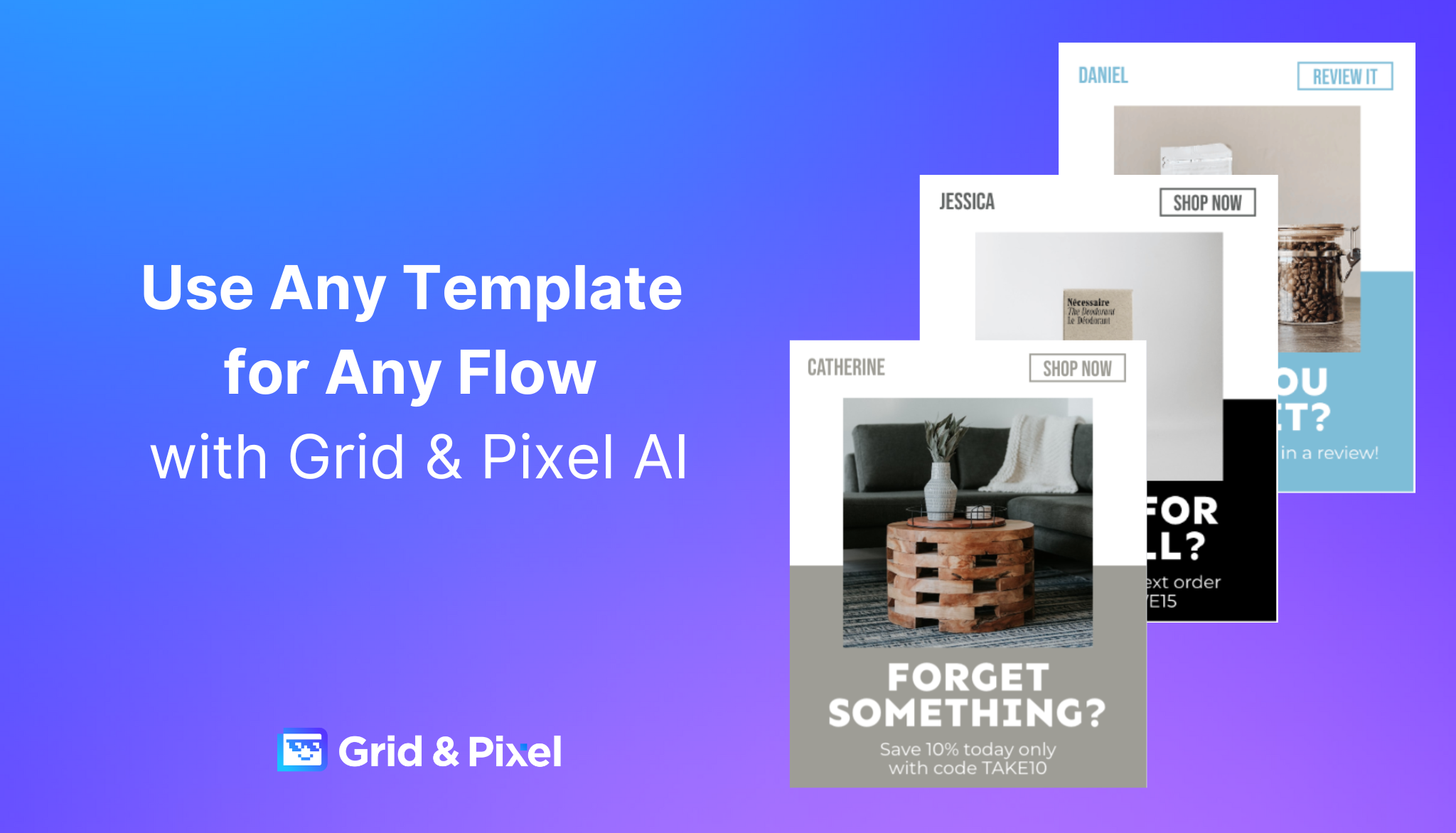
Here’s an example of one template being used for three different use cases:


You can customize the look of the graphic to match your use case (e.g. abandoned cart vs. product review), but you don’t have to worry about figuring out where it should link or what product images to use. It’ll all be dynamic depending on where you slot the graphic.
Personalized Links and Graphics Increase Clicks
Sure, you could link to your main website for every email — but that isn’t the best option for every use case. Taking someone to your main website is the furthest place they can be from completing checkout, so you want to bring them further down-funnel and closer to purchasing something when you can.
A personalized CTA could be something like the product page for an item they recently viewed, or the checkout page if they abandoned checkout before buying. And, if you’re using Grid & Pixel, these links will take different people to different places based on their user history. This makes for a more customized experience that drastically reduces friction to buy (and increases conversion).
You could see 2X as many clicks with a personalized CTA.
The same goes for graphics. Show someone a graphic that is personalized to them and their history with your website, and they are going to find it exponentially more relevant than something generic. It’s no surprise that personalization drives 6X better transactional rates and 40% more revenue for companies that use it.
Avoid the Question: “Why am I getting this email?”
Relevancy is what keeps customers opening, clicking, and happily subscribed to your newsletter list. They signed up to get emails because something about your shop resonated with them. Many of those customers are sending you unique signals about what that “something” is, so don’t ignore them.
If your customers are opening your emails and saying to themselves, “Why am I getting this email?” then it’s a recipe for customer dissatisfaction and potentially an unsubscribe. And that’s the ultimate dagger for digital marketing efforts.
Customers are frustrated when content is irrelevant to them.
At best it feels like a mistake, at worst it feels like you don’t actually understand them as a customer. Neither is good when competition for their attention and dollars is high.
With personalization, you can make sure your emails are always relevant. Customers will know they are getting a specific email because they looked at something on your website, started building a cart, or recently purchased something. And with Grid & Pixel, you can leverage personalization in a matter of seconds. You’ll have all the imagery and links aligned instantly so each customer’s unique path to placing an order feels like you’re rolling out the red carpet for them.
